
The national capital was in the grip of a cold wave, with the sun largely obscured by clouds and pollutants lingering in the atmosphere, leading to reduced visibility. At least 129 flights were cancelled at the Delhi airport on Saturday due to dense fog, according to an official.

The IMD has predicted "heavy to very heavy" rainfall in Mumbai on Sunday.

The IMD has red and orange alerts for the hours ahead.

A thick layer of toxic smog enveloped the national capital on Saturday as air quality deteriorated sharply, prompting the Commission for Air Quality Management (CAQM) to invoke the strictest curbs under Stage IV of the Graded Response Action Plan (GRAP) across Delhi-NCR.

A severe cold wave has intensified across North India, with Delhi recording its lowest temperature of the season. Rajasthan experienced sub-zero temperatures, and several states have issued alerts and closed schools due to the extreme conditions.

North India is shivering under an intense cold wave as temperatures plummet across the region.

'Monsoon is the pran (life) of our water system.' 'A weak monsoon will have a very negative impact on crops and people's lives.'

Heavy rains continue to batter Tamil Nadu, causing a rise in reservoir levels and prompting a red alert. Schools and colleges are closed in several districts as authorities prepare for potential flooding.

The aircraft, later, flew to Guwahati after an improvement in the weather conditions in Guwahati, said KC Meena, the director of the Maharaja Bir Bikram (MBB) Airport at Agartala.

Above-normal cold wave days are expected in some areas of central India, eastern Uttar Pradesh and Bihar during January 2026.
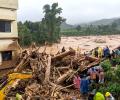
A red alert indicates heavy to extremely heavy rain of over 20 cm in 24 hours. An orange alert means very heavy rain of 11 cm to 20 cm, and a yellow alert means heavy rainfall between 6 cm and 11 cm.

Delhi choked under a thick blanket of smog on Monday, with the Air Quality Index (AQI) settling at 498, which falls in the higher spectrum of 'severe' category.

The India Meteorological Department (IMD) has predicted above-normal rainfall for most parts of India during the post-monsoon season (October to December), except for some areas in the northwest. The southwest monsoon season ended with the country recording eight per cent above normal rainfall.
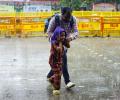
The record monsoon rains across India during the June to September months was 937.2 millimetres, the 5th-highest since 2001 and 38th-highest since 1901.

Heavy rains lashed Mumbai, slowing traffic and affecting train services. The IMD has issued an 'Orange' alert, advising citizens to stay indoors.

The BCCI press conference scheduled at 1.30pm in Mumbai is 'expected to be delayed owing to weather disruptions'.

Mumbai recorded a minimum temperature of 16.5 degrees Celsius on Friday, the lowest for November in the last eight years, the India Meteorological Department (IMD) said. This temperature was recorded by the Santacruz observatory, which records weather parameters for Mumbai's suburbs. The Colaba observatory, which records weather parameters for the island city, registered a minimum temperature of 21.4 degrees Celsius during the same period. There is no cold wave alert for Maharashtra from November 30 to December 3, and temperature is set to rise.

A landslide triggered by continuous rainfall has disrupted traffic on National Highway 75 near Kadaba taluk in Dakshina Kannada district, halting vehicular movement between Bengaluru and Mangaluru. Authorities are working to clear the debris and restore traffic flow.

IMD weather forecast predicted a moderate to intense spell of rain in these areas for the next three to four hours.
The India Meteorological Department (IMD) has forecast cloudy skies with the possibility of heavy rainfall at a few places in the city and suburbs in the next 24 hours.
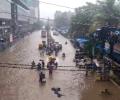
Heavy rains in Maharashtra have caused floods, road blockages, and widespread damage, resulting in casualties and displacement. The state government is monitoring the situation and coordinating rescue efforts.

The India Meteorological Department (IMD) forecasts the withdrawal of the southwest monsoon from northwest India around September 15. This year's monsoon covered the country earlier than usual, resulting in surplus rainfall and extreme weather events.

Heavy rains in Nanded, Maharashtra, have caused severe flooding, leading to the evacuation of hundreds of residents as the Godavari and Asna rivers overflow. The Vishnupuri dam released a large amount of water, exacerbating the situation.
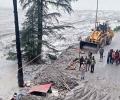
Experts question whether a cloudburst caused the recent flash flood in Uttarkashi, India, citing insufficient rainfall and other potential factors like ice chunks, rockfalls, or landslides.
Delhi is preparing for its first artificial rain through cloud seeding to combat air pollution. A trial run was successful, and the first rainfall is expected on October 29 if weather conditions are favorable.

Delhi experiences a biting chill with 'cold day' conditions and dense fog, coupled with 'very poor' air quality. The IMD forecasts continued cold weather and potential light rain.

'Threat assessment, intelligence analysis, (battlefield) situation review -- what has transpired in the last three hours -- was conducted with the help of AI.'

Incessant rains and water-logging slowed down traffic in Mumbai, with the IMD issuing a 'red alert', predicting very heavy showers in the city and neighbouring areas. Commuters faced water accumulation on tracks and delays in local train services.

Heavy rains caused severe waterlogging, traffic jams, and disruptions to local train services in Mumbai. Schools and colleges were closed due to a 'red alert' issued by the IMD.

The country also reported 1,750 deaths due to extreme weather events such as floods, cyclonic storms, heavy rain, landslides, lightning, among others, during the year, it said.

A landslide in the Vikhroli suburb of Mumbai killed two people and injured two others after heavy rains caused soil and stones to collapse on a hut.

Mumbai Indians were the first team to leave the field while Delhi players stayed back doing light training but were eventually forced to call it off.
The early onset of the southwest monsoon brought continuous rainfall across southern and eastern India, contributing to this record.

Heavy rains lashed Delhi, leading to a red alert, traffic snarls, and waterlogging. The IMD predicts continued rainfall.

'We are stuck in a very bad situation. Thank you so much #NDRF for rescuing us,' Radha captioned the post, expressing her gratitude for the timely assistance.

Seven people died after a wall collapsed near Mohan Baba Mandir in Jaitpur, Delhi, following heavy rainfall. Rescue operations were conducted by police, fire services, and NDRF teams. An investigation is underway to determine the cause of the collapse.
The southwest monsoon arrived in Maharashtra on Sunday, making it the earliest onset of the annual rainfall season over the state in 35 years, according to the India Meteorological Department. The monsoon is expected to advance to Mumbai and some other parts over the next three days. The monsoon advanced into some more parts of the Arabian Sea, Karnataka, entire Goa, parts of Maharashtra, north Bay of Bengal, and parts of Mizoram, parts of Manipur and Nagaland on Sunday. The northern limit of monsoon passes through Devgad, Belagavi, Haveri, Mandya, Dharmapuri, Chennai, Aizawl and Kohima. Conditions are favorable for further advance into some more parts of central Arabian Sea, more parts of Maharashtra including Mumbai, Karnataka including Bengaluru, some parts of Andhra Pradesh, remaining parts of Tamil Nadu, more parts of west-central and North Bay of Bengal and some more parts of North Eastern states during next three days. The southwest monsoon hit Kerala on Saturday, marking its earliest arrival over the Indian mainland since 2009.

Heavy rains across India have led to widespread flooding, causing damage to infrastructure, displacement of residents, and disruption of normal life. Rescue efforts are underway in affected areas.

From a few rain gauges in 1875 to rivalling the world's best weather agencies, the India Meteorological Department (IMD) has weathered its way to becoming a global leader in forecasting.

West Bengal Chief Minister Mamata Banerjee has accused the Damodar Valley Corporation (DVC) of releasing water recklessly and without prior intimation, creating a flood-like situation in south Bengal districts during Durga Puja.
